
PART 1 The “Shall” Illusion When Rules Are Optional in Nashua
Sunshine Week is supposed to celebrate the public’s right to understand what their government is up to. But in Nashua, transparency often feels more like a suggestion than the rule it is intended to be.
The city’s Ethics Review Committee (ERC) was created to hold public officials accountable. Its governing ordinance is filled with clear legal mandates, rules written with the word “shall.”
In law, shall does not mean “maybe.” It does not mean “when convenient.” It means mandatory. It gives citizens a legal hook to hold the government accountable. But in Nashua’s ethics process, shall has boldly become optional.
Most municipalities in New Hampshire establish ethics review committees under RSA 31:39-a, which allows cities to adopt ordinances regulating conflicts of interest and misconduct by public officials. These committees function as quasi-judicial bodies, operating under a hybrid of municipal procedures and court-like rules.
Nashua’s Board of Aldermen adopted such an ordinance under Chapter 12, Article IX of the Nashua Revised Ordinances. The ordinance lays out a structured process for how ethics complaints are handled and investigated.
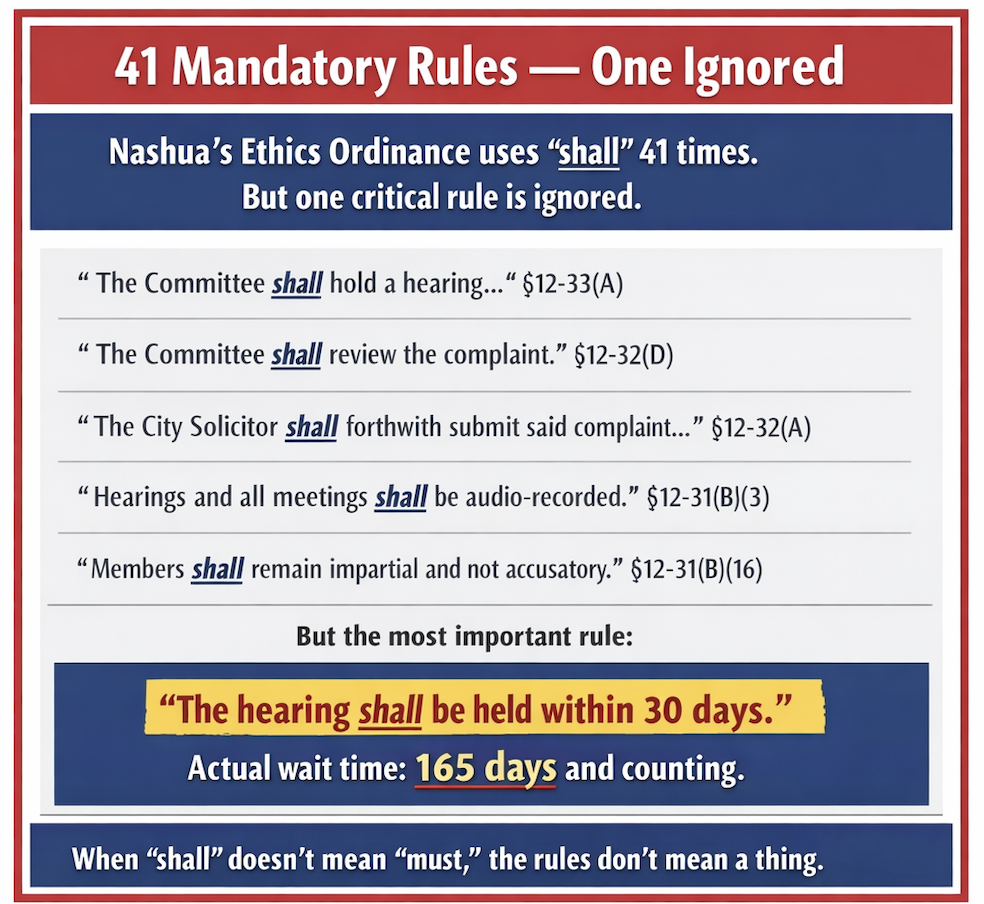
And the Ordinance uses the word “shall” 41 times. In legal drafting, that word carries weight. It creates a binding obligation on the government and gives citizens a corresponding right to expect compliance. But that expectation assumes the rules are actually followed.
One of the clearest mandates in Nashua’s ordinance is the timeline for handling ethics complaints.
The rules state that a hearing shall be held within 30 days of receiving a complaint. That language appears straightforward. If a complaint is filed, the process moves quickly so that accusations are resolved while facts are still fresh and reputations are protected. But that is not what happens in practice for my complaints. It does happen for other people’s complaints.
Two complaints I filed in 2023 did not even receive its initial screening meeting until 130 days later. Another complaint filed in September of 2025 has now been waiting more than 165 days without a screening meeting, let alone a hearing.
At that point, the 30-day mandate is not merely delayed. It is completely ignored. The ERC and sole arbiter, Chairman Attorney Bush have turned the “shall” into whenever I feel like it with no communication to the parties involved. The rule is not functioning as law at all.
But there is a loophole. Rule §12-32(D) states:
“The first Committee meeting with the complaint on the agenda shall constitute the Committee’s receipt of the complaint.”
Under this definition, a complaint is not considered “received” when it is filed with the City. Instead, it is only considered received when the Committee chooses to place the matter on its agenda.
Ethics rules are supposed to protect both the complainant and the accused by ensuring that allegations are addressed promptly. Delayed hearings damage reputations, discourage citizen participation, and undermine confidence in the process. When the definition of “receipt” allows the timeline to float indefinitely, the word “shall” begins to lose its meaning.
The Chair controls the Committee agenda. As Chair, Attorney Tim Bush controls when complaints are placed before the Committee, and several of my complaints have remained pending for months without being scheduled.
In another twist, emails produced by the ERC clerk show that the administrative practice inside City Hall interprets the rule differently. In those emails, the clerk notifies committee members that an ethics complaint has been received and advises that a hearing must be held within 30 days, while proposing available meeting dates.
In other words, the City’s own staff appears to interpret the ordinance the way any reasonable person would: the clock begins when the complaint arrives at City Hall.
The deeper problem may lie in how these committees are formed. In Nashua, the Mayor nominates the members of the ERC, and the Board of Aldermen confirms them.
That structure is common across many municipalities, but it creates an obvious risk. When political leadership and committee members share the same alliances or loyalties, the committee can drift away from independence.
Instead of acting as an impartial body evaluating conduct, it can become something else entirely: A political tribunal reviewing complaints about the very officials who appointed them.
Ethics committees are supposed to strengthen public confidence in government. Their job is not merely to enforce rules, but to demonstrate that public officials are accountable to the same standards they impose on others. But when mandatory timelines are ignored and my complaints languish for months without action, the process begins to resemble something different. It is a theatre show with the appearance of accountability front and center rather than accountability itself.
And four citizens who filed complaints have noticed that gap between written rules and actual practice and have called it out. But Attorney Bush continues to refuse to acknowledge those concerns or permit his committee to discuss the Rules in a public meeting, even when hired counsel to advise the ERC has recommended the Board do so. There is no credibility in the committee; it is a Kangaroo Court.
That leads to a deeper question. If the rules say “shall” but the committee behaves as though they don’t apply, who exactly is enforcing the ethics process? That question becomes even more troubling when we look at how the committee handles complaints involving city leadership.
That story is the subject of Part Two.